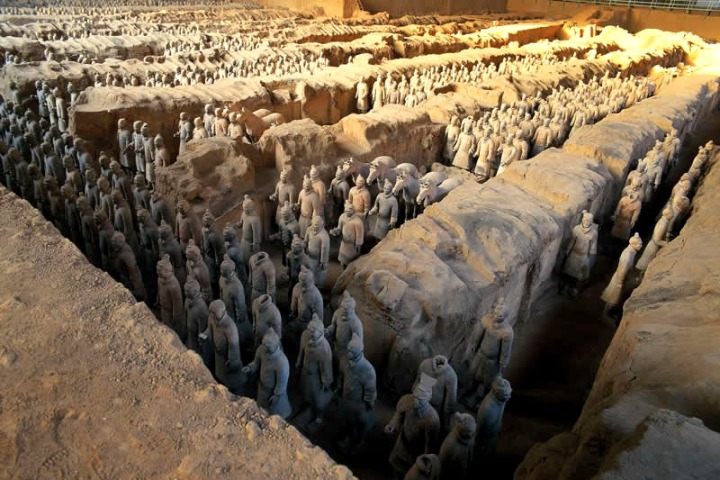
Mausoleum of the First Qin Emperor
Introduction
The Mausoleum of the First Qin Emperor, or the Qinshihuang Mausoleum, is located in Lintong county, near Xi'an city, the capital of Shaanxi province, China. This remarkable historical site is also known as the Lishan Mausoleum as it lies on the north hill of Lishan Mountain, and it houses the famous terracotta warriors and horses. Constructed between 246 BC and 208 BC, this mausoleum that spreads over an area of 56.25 square kilometers is notable for being the first of its kind in Chinese history. It is an immense archaeological complex that includes a grave mound, numerous pits, and an array of burial tombs. The mausoleum is recognized as a UNESCO World Heritage Site, having been listed in December 1987, due to its outstanding universal value.
History and Construction
Historical Context
The Mausoleum of the First Qin Emperor was commissioned by Emperor Qinshihuang, the founder of the Qin Dynasty and the first emperor to unify China in the 3rd century BCE. This unification marked a significant turning point in Chinese history as it established the foundation for future centralized governance. The construction of the mausoleum began in 246 BCE, soon after Emperor Qinshihuang ascended the throne, and continued until his death in 210 BCE. It was a monumental project that involved massive resources and manpower, symbolizing the emperor's supreme authority and ambition to solidify his legacy.
Construction Techniques
The mausoleum's construction exemplifies the architectural and engineering prowess of the Qin Dynasty. The grave mound originally stood at 76 meters high, though erosion and human activities have reduced its height over time. The mausoleum is designed with precise alignments, mirroring the urban plan of Xianyang, the capital city of the Qin Dynasty. The construction incorporated advanced techniques for that era, involving skillful craftsmanship in pottery, metallurgy, and architecture. The terracotta soldiers and horses are notable for their life-size proportions and intricate details, showcasing the superior skills of artisans in sculpture and bronze work.
Archaeological Discoveries
Terracotta Army
The discovery of the Terracotta Army is one of the most significant archaeological finds of the 20th century. Unearthed in 1974, the army comprises over 8,000 life-sized figures of warriors, horses, and chariots, each with distinct facial expressions and attire, revealing a high degree of craftsmanship and attention to detail. The figures are arranged in battle formations, facing east, indicating their role as protectors of the emperor in the afterlife. The terracotta warriors provide crucial information about the military strategies, uniforms, and weapons of the Qin Dynasty, illustrating the historical and cultural context of that era.
Other Artifacts
In addition to the terracotta warriors, the Mausoleum of the First Qin Emperor has yielded numerous other artifacts that helped shape the understanding of Qin Dynasty art and technology. Excavations have uncovered a wealth of bronze weapons, such as arrows, spears, and swords, which remain remarkably well-preserved and sharp despite being buried for over two millennia. These items, composed of bronze with various metal alloys, were engineered to resist rust, showcasing advanced metallurgy techniques of the time. Further discoveries include bronze chariots, pottery, and ornamental items, each contributing to the broader picture of life and craftsmanship during the Qin period.








